At halftime in a packed football stadium, a robot walked onto the pitch carrying the match ball. It did not stumble. It did not freeze beneath the lights. It completed a few goal celebrations, handed over the ball and left the field. The appearance lasted minutes, but it captured the strange position humanoid robots now occupy: somewhere between industrial equipment, scientific achievement and celebrity.
The robot was Atlas, Boston Dynamics’ electric humanoid. Its World Cup appearance on 5 July was designed as spectacle, but the company described the noisy, unpredictable stadium as a test of the same reliability required in a factory. Atlas’s less glamorous future is not performing to thousands of football fans. It is moving parts around Hyundai facilities. 1
This difference—between what a robot looks impressive doing and what it can reliably do for eight hours—is the whole story of the humanoid moment.
We have spent years asking whether a machine can move like us. We are about to discover what happens when it works beside us.
The demonstration is over
Humanoid robots have always been unusually good at attracting attention. A wheeled warehouse robot can transform a business and never appear on the evening news. Give a machine two legs, a head and arms, and every movement becomes a preview of the future.
That resemblance has sometimes hidden the engineering reality. Walking is difficult, but useful work requires far more: seeing irregular objects, choosing a safe grip, recovering when a part moves, navigating around people and repeating the same sequence without turning a small error into a dangerous one.
Boston Dynamics says the production Atlas has 56 degrees of freedom, can lift up to 50 kilograms and swap its own batteries. The first 2026 deployments are committed to Hyundai and Google DeepMind. The machine can be autonomous, teleoperated or steered with a tablet. 2 These are not the usual specifications of a domestic helper. They are the requirements of enterprise equipment.
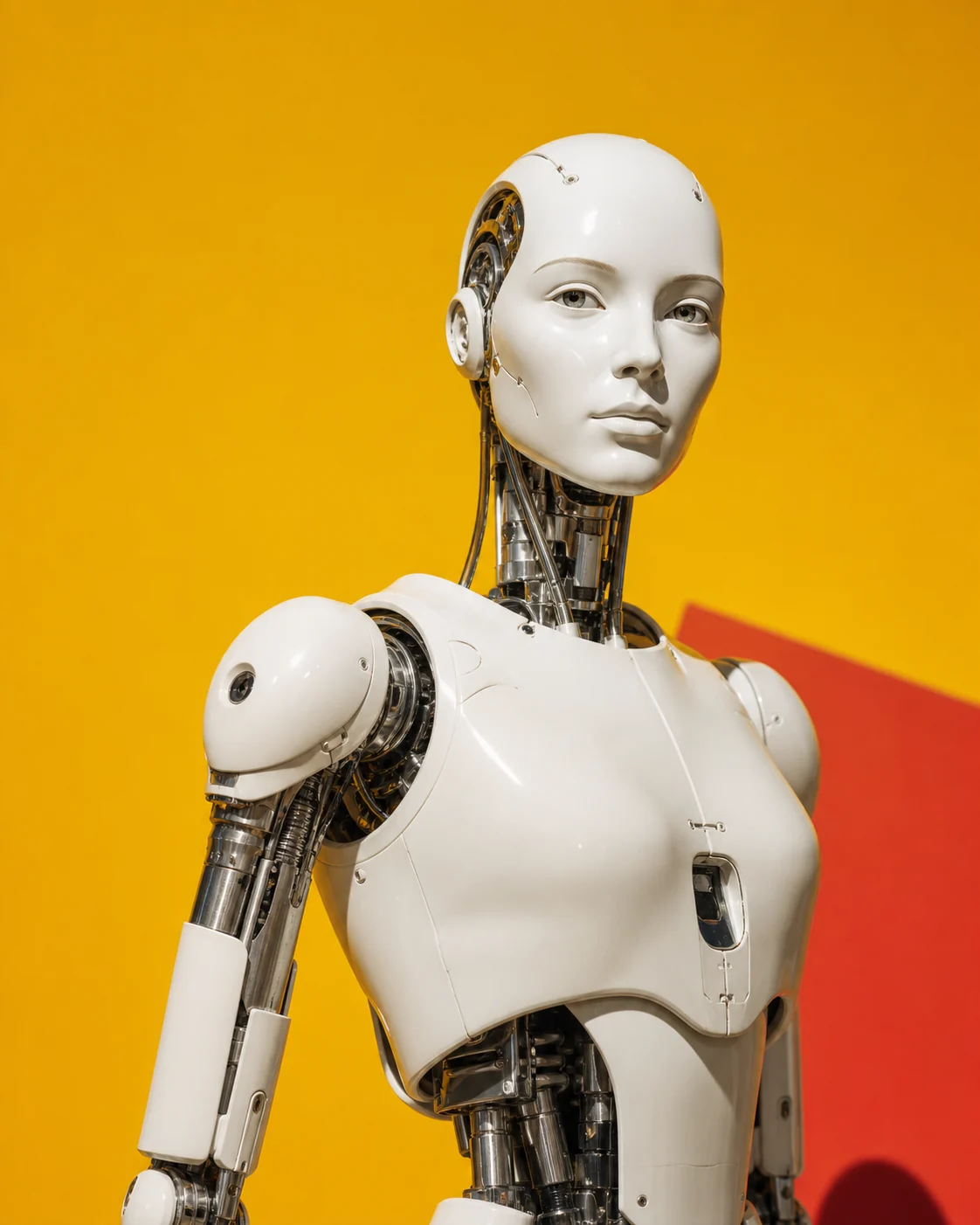
Why does it need to look like us?
The strongest argument for the humanoid shape is not emotional. It is architectural. Our workplaces are designed around our proportions. Shelves sit at the height of human arms. Doors, ladders, stairs and tools assume a particular kind of body. A machine with roughly the same reach and footprint can enter those spaces without requiring the entire environment to be rebuilt.
But resemblance should not be confused with imitation. Atlas’s joints can rotate in ways ours cannot. A useful industrial humanoid may turn its torso through an angle that looks unsettling to a person because turning that way is faster and safer for the task. The human form is a compatibility layer, not a costume.
That distinction matters outside the factory. A robot designed for a hospital, school or home is not simply industrial hardware with a friendlier face. The closer a machine gets to vulnerable people, the more important its social behaviour, privacy rules and lines of responsibility become.
The first job is not “everything”
The phrase “general-purpose robot” is irresistible and almost useless. Every impressive video encourages us to imagine one machine cooking breakfast, folding laundry, caring for an older parent and repairing a leaking pipe. Commercial reality begins somewhere narrower.
Atlas’s first focus is automotive part sequencing: selecting and arranging different components so workers can retrieve them at the assembly line. It is repetitive, physically demanding work involving lifting, squatting and twisting. It is also varied enough to test perception, gripping and whole-body coordination. Boston Dynamics argues that this combination gives the task both technical value and a real business case. 3
That is the pattern worth watching. A humanoid will not arrive as a universal worker. It will arrive as a machine that can do one difficult class of tasks, then acquire more skills through software, demonstrations and fleet learning.
The revolution will look less like a robot butler and more like a procurement decision.
Work changes before home does
Factories provide something homes cannot: controlled access, trained operators, repeatable environments and an economic reason to tolerate early limitations. They are where the industry can learn what breaks, which tasks transfer between sites and how humans behave when a machine shares their space.
The labour question is therefore immediate, even if mass domestic adoption is not. Companies often describe robots as answers to unsafe work and labour shortages. Workers may reasonably ask whether “reskilling” comes with the investment, time and job security the word implies. A robot can reduce injury and still concentrate power. Both can be true.
The useful debate is not “robots or no robots.” It is about deployment: which tasks should be automated, what evidence is required before a robot operates without a barrier, what happens when it causes harm, and whether productivity gains are shared with the people whose work made the system possible.
Trust is a feature you cannot demo
A backflip can be filmed once. Trust is accumulated through thousands of unremarkable hours. It depends on predictable stopping behaviour, clear maintenance records, understandable controls and a visible chain of accountability. It also depends on knowing when a machine is being operated remotely and what its cameras are recording.
The most revealing humanoid stories over the next few years will not be the loudest. They will be incident reports, worker interviews, maintenance schedules and the gradual expansion from one task to five. The measure of progress will be whether a robot becomes boring enough to be useful.
That is why this is the humanoid moment. Not because the machines have suddenly become human, but because they are becoming products. The dream has acquired a supply chain, a service plan and a place on the factory floor. What comes next will be shaped as much by managers, workers, regulators and communities as by roboticists.